What Does Your Love Percentage Score Really Mean? A Complete Guide
Want to test this directly? Calculate your score with our free tool.
When you test your relationship on a love percentage calculator, seeing a high number feels exhilarating. But what do the numbers actually signify, and how should a couple interpret scores across different bands?
Understanding Compatibility Tiers
Compatibility isn't about identical twins thinking the same thought every second. It is about emotional harmony, conversational ease, and mutual support. Here is how relationship coaches view compatibility spectrums:
The Four Pillars Beneath the Percentage
A single percentage score is composed of four crucial relationship dynamics:
1. Communication Flow: Can you share vulnerable fears without feeling judged?
2. Emotional Harmony: How do you respond when the other person is anxious or fatigued?
3. Passion & Chemistry: The romantic spark that turns companionship into heartfelt intimacy.
4. Longevity & Commitment: Alignment on long-term values, family priorities, and lifestyle goals.
A high percentage is an invitation to celebrate your bond. A lower score is a reminder that relationships are built through conscious love, not pre-programmed fate.
How the Love Percentage Is Worked Out
A love percentage by names result starts with two names and a fixed formula. The calculator turns the letters into numbers, compares the two sets, and returns a percentage — the same two names always give the same number, which is why a result you can reproduce feels more trustworthy than one that changes on refresh.
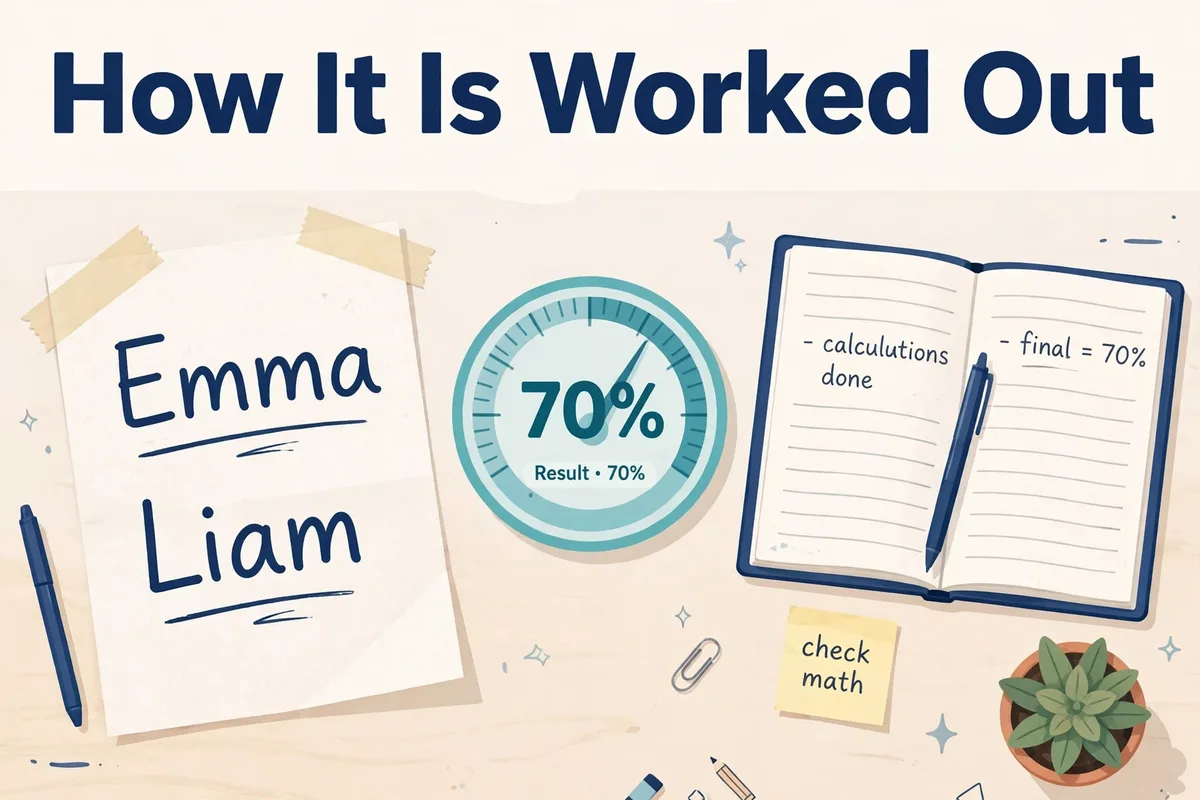
To check love percentage again, enter the same two names in the same order and compare the new result with the old one. If the number moves, the tool is randomising; if it holds steady, the method behind it is consistent, even if the number itself is only a playful estimate.
A love percentage test is only as honest as the method behind it. Name-based tests are quick and fun, date-of-birth tests add a numerological layer, and neither can see how two people actually treat each other — that part of compatibility never fits inside a percentage.
The percentage itself is a summary, not a measurement. It compresses communication, humour, patience, and shared goals into one number, so a high score means the inputs lined up well, and a low score means the formula found less overlap — not that the relationship is doomed.
Love Percentage Apps and Everyday Questions
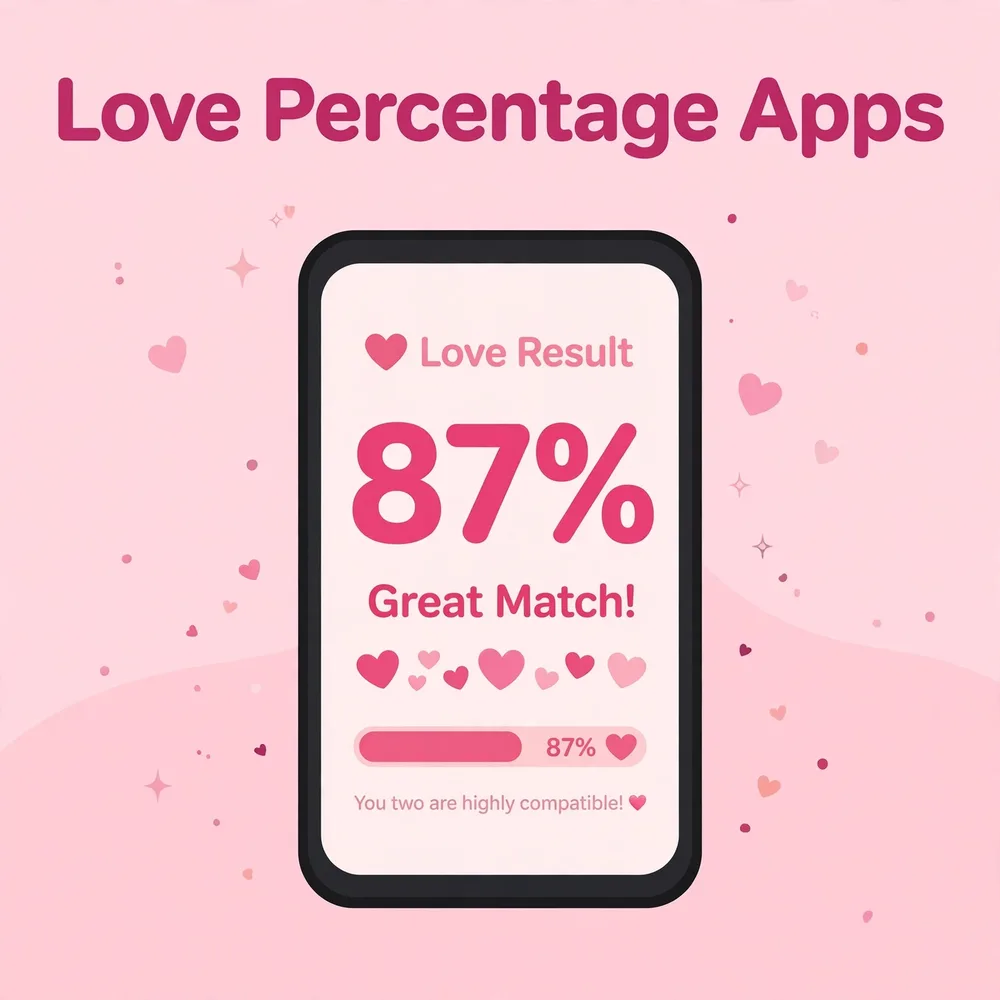
A love percentage app does the same calculation on your phone, usually with a prettier screen and a share button. The better ones show their method and let you re-run the same pair; the weaker ones hide behind animations and ads. Pick the one that explains itself.
One of the stranger searches around this topic is how to remove love percentage, and the answer is simpler than the question suggests: there is nothing stored to remove. The percentage is a result shown on screen, not a record kept about your relationship — run a new calculation and the old number is gone.
If you search love percentage kaise nikale, you are asking in Hindi how the number is worked out. The answer is the same in any language: two names go in, a formula compares them, and a percentage comes out. What changes is only the wording, not the arithmetic.
Games and quizzes built around the percentage work the same way, with a lighter tone. A love percentage game usually adds animations or a story around the result, but underneath it is the same name comparison — enjoy the wrapping, and judge the result by whether the method is shown.
Helpful Relationship Guides
View all articlesHow Online Love Calculators Work: Formulas, Names & Compatibility
Understand the mathematics behind name-based love calculators, character hashing, and why deterministic matching offers fun relationship insights.
Love Marriage vs. Arranged Marriage: Compatibility in Modern India
Explore the modern evolution of Indian matrimonial partnerships, blending romance with family blessing, and testing your relationship alignment.
Explore Related Compatibility Tools
True Love Calculator & Percentage Compatibility
Master compatibility test between two names. Analyzes letter vibrations, vowel harmony, and 4-pillar relationship scores.
FLAMES Calculator Game
Authentic school & college FLAMES test (Friends, Lovers, Affectionate, Marriage, Enemies, Siblings) with letter elimination.
Friendship & Bestie Loyalty Calculator
Check best friend compatibility, loyalty score, secret-keeping quotient, and shared humor meter with official dosti pact cards.