Love or Arranged Marriage Calculator
Will your path be a self-discovered love marriage or a traditional family-guided alliance? Explore your alignment with custom relationship advice.
Shaadi Ki Sambhavna: Balancing Love & Family Harmony
In India, a marriage is never just a union of two individuals; it is the blossoming alliance between two families, life philosophies, and shared dreams. Whether you found each other organically or through familial matchmaking, lasting marital joy stems from mutual respect, emotional transparency, and aligned expectations.
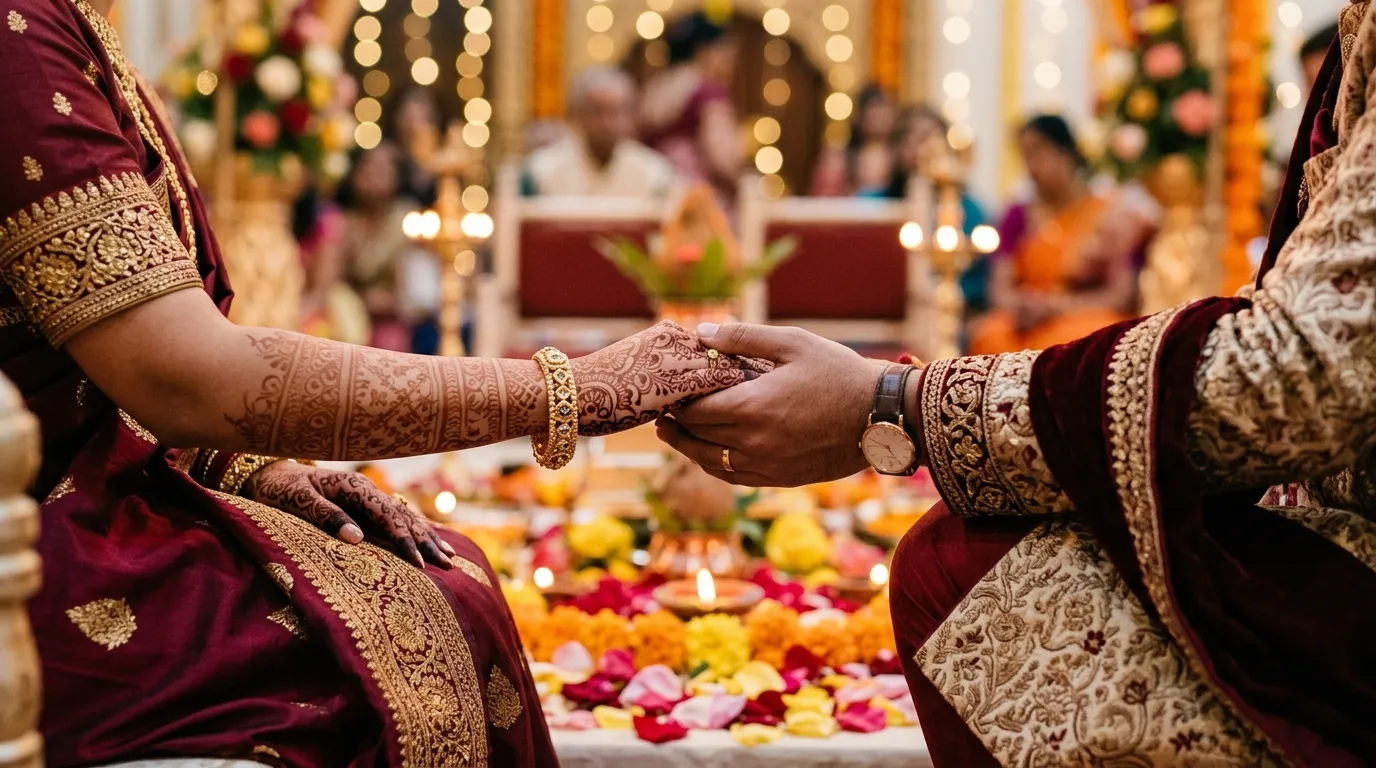
Love Marriage vs. Arranged Marriage: The 'Love-Cum-Arranged' Era
The stark divide between 'pure love marriage' and 'traditional blind arranged marriage' has largely dissolved in modern society. Today, progressive Indian matrimonial alliances celebrate autonomy combined with family blessings:
Organic Love Marriage
Born out of college dating, workplace camaraderie, or mutual friend circles. Partners develop strong emotional bonding and shared memories before bringing families into the discussion.
Love-Cum-Arranged (The Sweet Spot)
Families initiate the introduction via matrimonial platforms or relatives, but the couple is granted 6 to 12 months of unmonitored courtship, coffee dates, and travel to evaluate romantic chemistry independently.
Traditional Family-Guided Alliance
Prioritizes socio-cultural symmetry, astrological Kundli Milan (Ashtakoota), joint family harmony, and parental vetting, allowing romantic affection to blossom post-nuptials through dedication.
The 5 Pillars of Lifelong Marriage Compatibility & Readiness
Marriages thrive not on fairytale perfection, but on resilient everyday partnership across these key areas:
1. Romance & Intimacy
Maintaining passion, flirtatious banter, and intentional date nights even amid busy work routines and household responsibilities.
2. In-Law Harmony
Navigating parental expectations with grace, setting healthy boundaries, and ensuring both sets of parents feel cherished and respected.
3. Financial Alignment
Openness about savings, EMIs, investments, lifestyle expenditures, and mutual goals for purchasing a home or building family wealth.
4. Dual-Career Support
Celebrating each other's professional milestones, equally sharing chores, and accommodating job relocations or late work hours.
5. Fair Conflict Rules
Banning insults or silent treatment during disputes; focusing on solving the problem together rather than winning an argument.
The Premarital Checklist: 8 Crucial Discussions Before Tying the Knot
Before printing wedding invitations or conducting roka ceremonies, discuss these practical lifestyle questions with your partner:
Living Arrangements (Nuclear vs Joint Family)
Will you live with parents, near parents, or independently in a separate apartment? Clarify short-term vs long-term expectations.
Financial Transparency & Joint Accounts
How will monthly household bills, rent, and discretionary personal allowances be split? Are there existing student loans or personal debts?
Career Mobility & Ambition Pacing
If one partner receives an overseas promotion or transferable government posting, how will the couple adapt their professional lives?
Children, Timing & Parenting Styles
Do you both wish to have children? What is the ideal timeline, and what role will grandparents play in daily childcare?
Religious Beliefs & Festive Traditions
How will Diwali, Eid, Christmas, or regional festivals be celebrated between two diverse family traditions?
Division of Daily Domestic Responsibilities
Who manages grocery runs, cooking, domestic helper coordination, and laundry on weekdays vs weekends?
Personal Space & Social Freedom
How much individual alone time, friend-group nights, and personal hobby pursuits does each partner require to recharge?
Crisis & Stress Coping Mechanisms
When faced with job loss, medical emergencies, or grief, how does each person react—by withdrawing or seeking immediate verbal comfort?
How a Love or Arranged Marriage Calculator Works
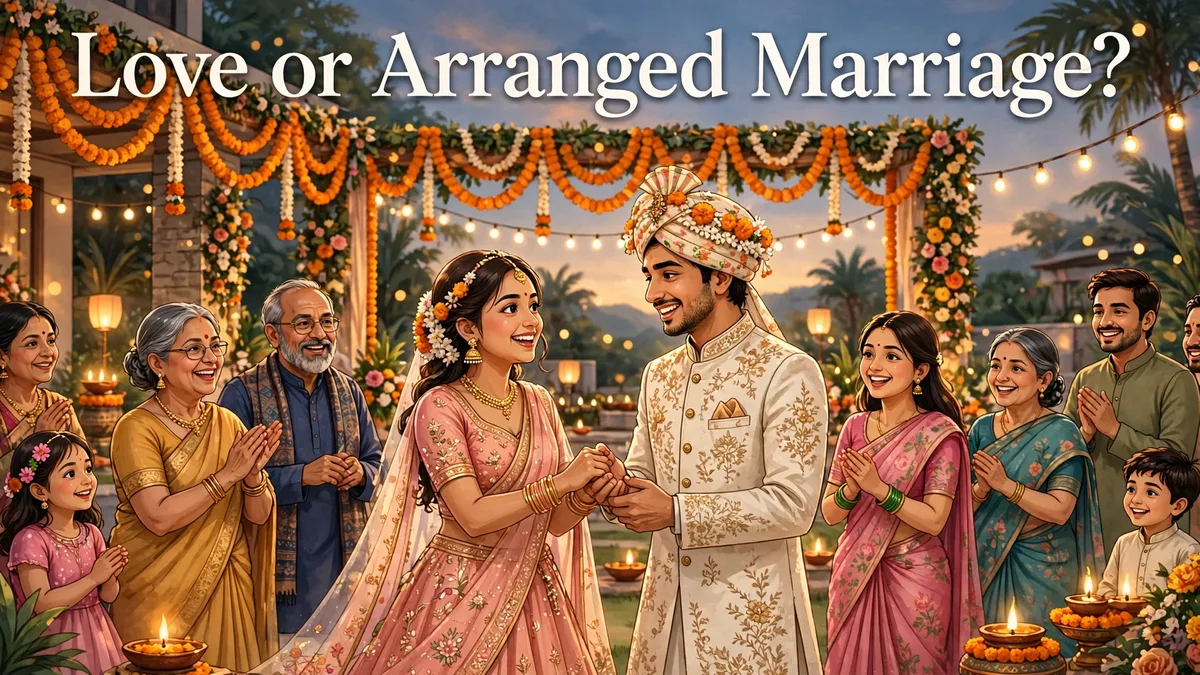
Two names and a few honest answers go into a love or arranged marriage calculator, and two numbers come out: the chance your marriage is a love marriage, and the chance it is arranged. The tool above works the same way — the names feed the name matching, the courtship time and the family slider set how much weight tradition carries, and the result shows both sides instead of picking one for you.
At its simplest, a love marriage calculator takes two names and returns one score. Run this tool with names alone and it behaves as a love marriage calculator by name — two names in, a score for how they sound together. Add courtship time and family priority, and the single score opens into the split: a love percentage and an arranged percentage, and the gap between them is the answer. A love marriage or arrange marriage calculator does not decide anything for you — it shows the split, and the split is what you discuss with your family.
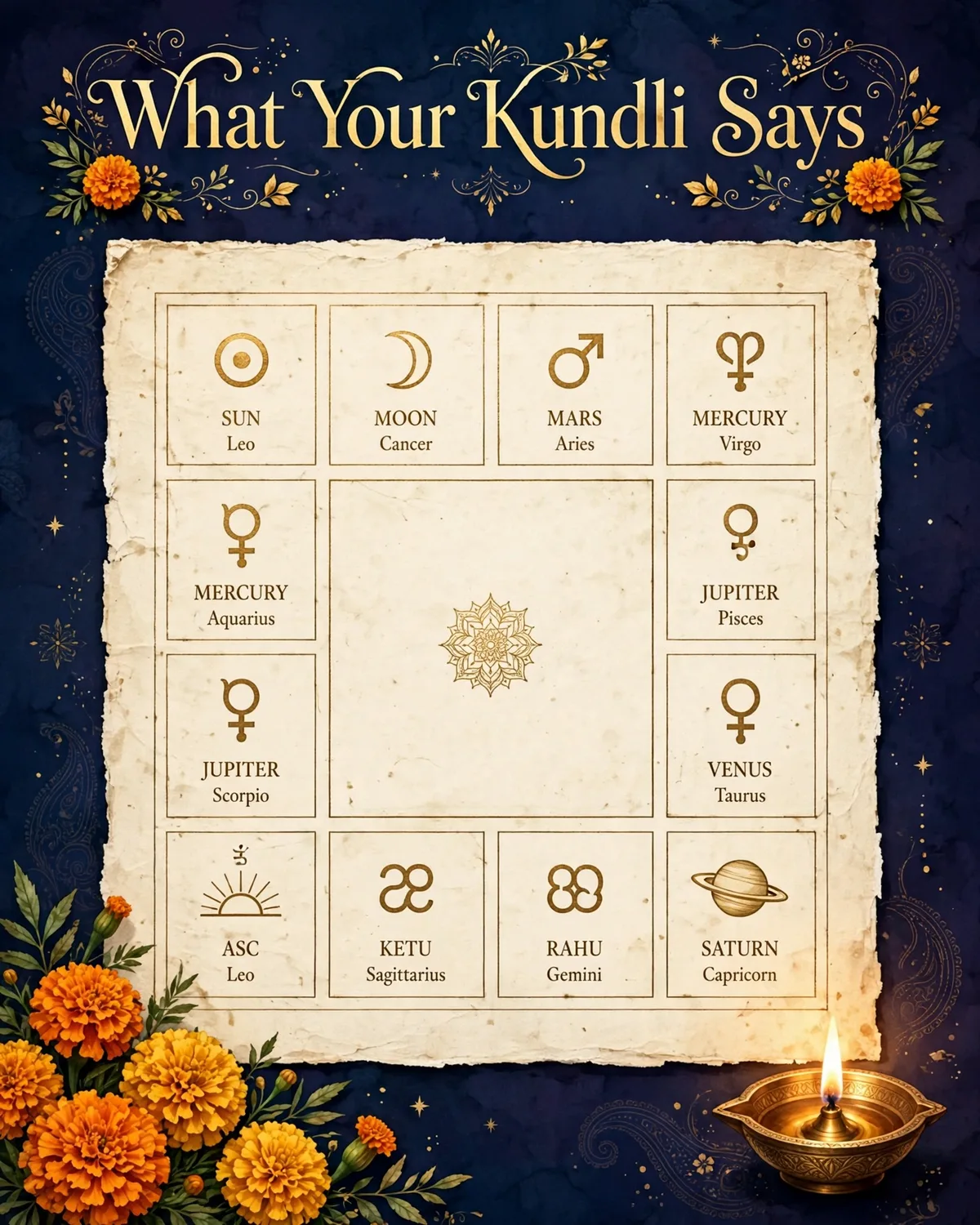
Love marriage astrology reads the question from the chart instead of from names: Venus and the 7th house show how love enters a life, and the 5th house shows how romance begins. When Venus sits in or aspects the 7th house, or the 5th and 7th lords exchange places, astrologers call it a love marriage yoga in astrology — a combination that points to a marriage the person chooses for themselves. Read a birth chart for that one question and you have a love marriage horoscope — which way the marriage goes, and when the timing supports it. To check love or arranged marriage in kundli, an astrologer starts with the 7th house and its lord, then looks at Venus, the 5th house, and the dasha running at the time — and the Kundali Matching page runs that reading for two charts at once, scoring the match out of 36. Tamil families read it through porutham instead, and a love marriage porutham reading compares the two stars across ten poruthams — the Porutham page runs the full matching.
A love or arranged marriage test by date of birth works differently again: it reads the birth chart for the marriage yogas and the dasha running at the age of marriage, and the When Will I Get Married page runs that reading. The date of birth matters because the chart is fixed at birth, so a love or arranged marriage by date of birth reading starts from the 7th house and its lord, then checks Venus and Jupiter before it says anything about timing. Pair the names with a birth date and the reading becomes a love marriage calculator by date of birth: the chart joins the names, and the 7th house carries the most weight.
What People Look For: Signs, Palm Lines and Numbers
Before anyone opens a calculator, most people look for signs. Here is what those signs are — and how much weight each one carries.
The first place people look is the chart, for what astrologers call love marriage hone ke sanket — the signs of a love marriage: Venus strong in the chart, the 7th lord placed well, a friendly aspect between the 5th and 7th houses. No single sign decides anything on its own; they are read together, the way the tool on this page reads names, courtship and family together, and the reading only means something when the whole picture points the same way.
Palm readers look somewhere else entirely: the love marriage line, the small line under the little finger that they say shows how marriage arrives. A long clear line is read as a love marriage, a line that forks or fades is read as a marriage that needs family support — but palmistry is a folk reading, not a chart, and no line on a hand changes what the kundli or the calculator says.
Numbers get asked the same way. A numerology love or arranged marriage reading takes the life path number from the birth date and reads it for independence against tradition — a 1 or a 5 leans toward choosing for yourself, a 2 or a 6 leans toward family guidance — and the Numerology Calculator page works the number out from any birth date. The reading changes sign by sign too: an Aries chart reads differently from an Aquarius one, because the 7th house falls in a different sign for each, so the love compatibility by zodiac sign page reads two signs together instead of one chart alone.
The two percentages the tool gives are, in plain terms, the chances: the love percentage is the chance of a love marriage, the arranged percentage the chance of an arranged one. And the question most people actually type — love marriage hogi ya arrange, how to know — has a simpler answer than the chart: run the numbers above, read the 7th house, and see whether the two agree. When the calculator and the chart point the same way, families usually come around faster than when either one stands alone.
Explore Related Compatibility Tools
True Love Calculator & Percentage Compatibility
Master compatibility test between two names. Analyzes letter vibrations, vowel harmony, and 4-pillar relationship scores.
FLAMES Calculator Game
Authentic school & college FLAMES test (Friends, Lovers, Affectionate, Marriage, Enemies, Siblings) with letter elimination.
Friendship & Bestie Loyalty Calculator
Check best friend compatibility, loyalty score, secret-keeping quotient, and shared humor meter with official dosti pact cards.
Helpful Relationship Guides
View all articlesHow Online Love Calculators Work: Formulas, Names & Compatibility
Understand the mathematics behind name-based love calculators, character hashing, and why deterministic matching offers fun relationship insights.
Date of Birth Love Compatibility: Life Paths & Numerology Explained
Discover how birth dates reveal personality vibrations, Life Path harmony, and why birth numbers offer a grounded framework for mutual understanding.