How to Calculate Love Percentage on Paper
Master the nostalgic pen-and-paper method to test love percentage with names. Follow easy step-by-step addition rules with real worked examples.
Try Our Online Love Percentage Calculator
Skip manual notebook math! Enter your name and partner's name to calculate true love percentage, phonetic sound harmony, and download your free couple certificate.
How to Find Love Percentage on Paper: The 4-Step Rule
Generations of school friends and couples have used pen and paper to test love percentage before smartphones existed. Here is the standard method used across notebooks worldwide.
Step 1: Write Names with the Word "LOVES"
Take a blank sheet of paper. Write your name, followed by the word LOVES, followed by your crush or partner’s name in a single horizontal line.
Step 2: Count Letter Frequencies
Moving from left to right, count how many times each unique letter appears across the entire phrase. Ignore letters you have already counted so each letter is tallied once.
Step 3: Pair & Add the Numbers
Write the counts in a single number row. Add the first number to the last number (outer pair addition). Place the sum below. Next, add the second number to the second-to-last number, repeating inward.
Step 4: Reduce to Two Digits
Keep repeating this pairwise addition on each new row until you are left with exactly two numbers. Those two digits give you the result of your true love test on paper.
How to Check Love Percentage on Paper: Read Your Result Right
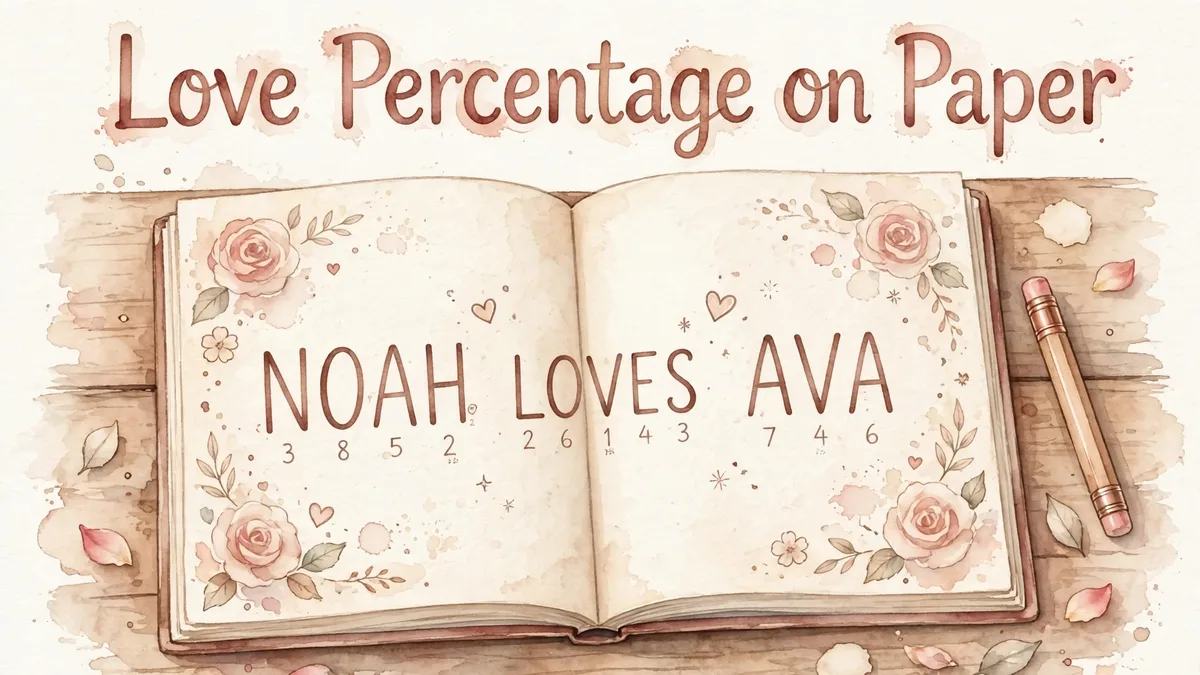
Learning how to test love percentage on paper takes one practice round: run the same two names through the counting and adding rounds a second time and compare the two rows — if a count differs somewhere, one of the tallies was wrong, and that is the most common reason two friends get different scores from the same names.
Anyone wondering how to take out love percentage on paper only needs to follow the rows to the end — the moment they shrink to two digits, the score is out, and writing it on the sheet itself keeps the working that proves it. A love percentage by names on paper comes only from the letters in the two names, so the same pair of names always produces the same rows.
This is how to calculate love percentage on paper with names when the first names are very short: start with full names rather than nicknames — longer names give longer count rows and more adding rounds, which makes a copying mistake easier to spot. The love calculator paper version travels where the online one cannot — into classrooms, onto trains, and onto any scrap of paper with a pen nearby. And if a friend asks how to do love calculator on paper, hand them your finished sheet and walk them through the count row — the method is easier to learn from a worked example than from rules.
When a love tester on paper gives a surprisingly low score, the first thing to check is the letter counts — one missed letter changes every row below it. Anyone wondering how to do a love test on paper only needs the four steps above — write the names, count the letters, add the pairs, and read the two digits that remain. The same counting also serves as a true love compatibility test on paper — the final two digits are read as compatibility between the two names, and the comparison table below shows what the online engine adds that paper cannot. To see what the number means, read what your love percentage means or check the same names on the online love calculator to compare the paper score with a phonetic reading.
Paper Love Calculation Example: AARAV & DIYA
Let us walk through an exact calculation using two popular names so you can follow along on your own sheet of paper.
Step 1: Write the Core Phrase
A A R A V L O V E S D I Y A
Step 2: Calculate Letter Occurrences
Initial Number Row: 4 1 2 1 1 1 1 1 1 1
Step 3: Pairwise Addition Rounds
The resulting paper love compatibility comes out to 88%, indicating high romantic affinity and warm conversational chemistry.
The "TRUE LOVE" Letter Match Method on Paper
Another beloved love calculator on paper involves writing the letters T-R-U-E L-O-V-E and counting matches against both partner names.
How It Works:
- Write your name and your partner’s name side by side.
- Underneath, write the 8 letters: T, R, U, E, L, O, V, E.
- Count how many times each of these 8 letters appears across both names.
- You will receive an 8-digit sequence (e.g. 1 2 0 3 1 1 0 2).
- Add outer numbers as before to reach your final two-digit percentage.
Why It Became Popular:
This method became iconic in school notebooks because it gave couples a standard 8-letter framework every time, regardless of whether names were short or long.
If you want an even more traditional game, try our dedicated FLAMES Calculator, which uses letter cancellation to reveal friendship, love, affection, marriage, enemy, or sibling status.
True Love Games on Paper: More Ways to Play
A true love game on paper needs nothing but two names and a pen — the counting and adding rounds are the game itself, and the score at the end is the prize. Every love test game on paper follows the same rhythm — write, count, add, read — so once you know one version, the others take a minute to learn. School notebooks are full of love games on paper because they cost nothing and any two names can start one.
The same counting shows how to find friendship percentage on paper — write two friends' names instead of a couple's, run the same rounds, and read the result as friendship rather than romance. It also works as a name compatibility game on paper: two names go in, the adding rounds do the work, and the final two digits are read as how well the names fit together — you can check the same pair on the name compatibility calculator or test the friendship on the friendship calculator instead.
FLAMES is another game you can play entirely on paper: cross out the matching letters in two names, count what is left, and strike through the word FLAMES until one letter remains. This is how to calculate flames on paper: count the leftover letters first — the count decides how many letters of FLAMES get struck through on each pass — and the FLAMES Calculator does the same striking online when you want it done instantly.
Paper Love Calculation vs. Online Love Calculator
Understanding the difference helps you enjoy paper calculations for nostalgic fun while relying on digital algorithms for richer relationship insights.
| Feature | Notebook Paper Method | CalculateLove Online Engine |
|---|---|---|
| Calculation Speed | 3-5 minutes with pen & paper | Instant (less than 1 second) |
| Algorithm Type | Manual digit summation | Deterministic phonetic harmonics + vowel vibration |
| Dimensional Breakdown | Only single overall percentage | 4 Pillars: Communication, Emotional Safety, Chemistry, Longevity |
| Age & Couple Dynamics | Not supported | Customizable couple vibes & age alignment |
| Shareable Love Card | Handwritten notebook page | High-res downloadable 1080×1350 certificate for WhatsApp Status |
| Privacy | Notebook can be seen by others | 100% private, executed locally in browser |
Explore Other Popular Love & Compatibility Tests
CalculateLove offers specialized compatibility calculators designed for every stage of your relationship journey:
Test true love percentage between two names with 4-pillar dimensional insights.
FLAMES Game Calculator →The classic school game that determines Friends, Lovers, Affection, Marriage, Enemies, or Siblings.
DOB Compatibility Test →Calculate Life Path number harmony (1-9) using both partners' dates of birth.
Helpful Relationship Guides
View all articlesHow Online Love Calculators Work: Formulas, Names & Compatibility
Understand the mathematics behind name-based love calculators, character hashing, and why deterministic matching offers fun relationship insights.
What Does Your Love Percentage Score Really Mean? A Complete Guide
Received a 75% or 95% love score? Discover how compatibility percentages translate to communication, emotional security, and shared goals.
How FLAMES Works: The Mathematical Guide to the Classic Nostalgic Game
Learn the exact rules of the FLAMES test: letter cancellation, count elimination, and the nostalgic history of India’s favourite school pastime.